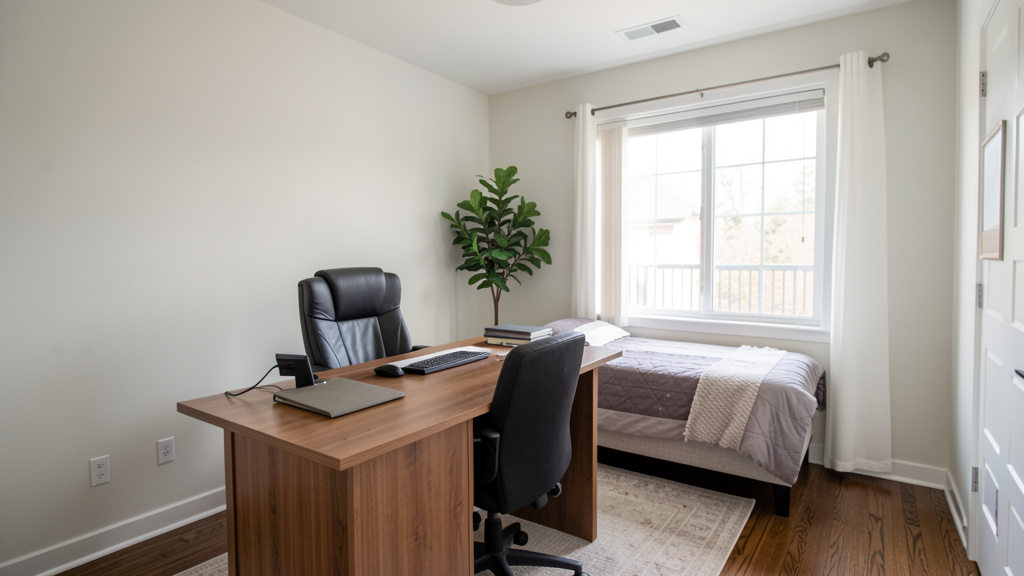
Design intentional boundaries that protect your focus, restore your energy, and honor both your professional ambition and personal life—without needing a spare room or expensive renovations.
You close your laptop at 5:30 p.m., yet your mind remains tethered to that unresolved email thread. Your child asks for help with homework while you’re still mentally drafting a report. Sunday evenings trigger low-grade dread because “home” no longer feels like a sanctuary. If this resonates, you’re experiencing the most common—and solvable—challenge of modern remote work: the erosion of boundaries between professional and personal life. This guide moves beyond superficial “set a schedule” advice to deliver an adaptable system informed by established principles from environmental psychology, behavioral science, and real-world application. Through intentional design tactics and flexible rituals, you’ll build a personalized boundary framework that feels natural, sustainable, and deeply restorative—whether you work from a closet-turned-office, a corner of your living room, or a multi-person household with competing needs. The goal isn’t perfection; it’s meaningful progress toward a home that supports both your productivity and your peace.
Introduction: Why “Just Try Harder” Fails
For decades, workplace psychologists have studied how environmental cues signal transitions between life domains. When your kitchen table doubles as your conference room, your brain receives conflicting signals: This is where I share meals with loved ones clashes with This is where I negotiate contracts. Neurologically, without clear sensory markers—distinct lighting, spatial arrangement, ritualized actions—your cognitive resources become fragmented. You aren’t lacking discipline; you’re operating in an environment engineered for boundary blur.
Research published in the Journal of Environmental Psychology indicates that intentional physical separation correlates with reduced work-home conflict and higher reported well-being among remote workers. Yet most advice overlooks a crucial truth: separation isn’t solely about square footage. It’s about intentional design. A dedicated room helps, but it’s neither necessary nor sufficient. True separation emerges from a synergistic blend of spatial cues, temporal rituals, and psychological anchors—what we call the Triad Framework. This approach integrates insights from environmental psychology, cognitive ergonomics, and behavioral science to transform how you experience your home workspace. Whether navigating a studio apartment, shared living space, or complex caregiving responsibilities, these strategies adapt to your reality. The framework acknowledges that boundary-building is iterative: small, consistent adjustments compound into lasting change.
The Triad Framework: Engineering Separation Across Three Dimensions
Most work-life balance guides fixate on time management (“log off at 6!”) while ignoring the physical and psychological scaffolding required for those boundaries to hold. The Triad Framework corrects this imbalance. It recognizes that sustainable separation requires reinforcing signals across three interconnected layers:
- Physical Layer: The tangible environment—sightlines, objects, lighting, sound—that cues your brain for work mode or rest mode.
- Temporal Layer: Ritualized transitions and time-based structures that create psychological “bookends” around your workday.
- Psychological Layer: Cognitive habits, communication norms, and internal narratives that reinforce your boundaries.
Neglecting any single layer weakens the entire system. Installing a room divider (Physical) without a shutdown ritual (Temporal) leaves mental residue. Setting strict hours (Temporal) without managing digital notifications (Psychological) invites constant intrusion. The Triad Framework ensures all three layers work in concert. Below, we dissect each layer with actionable steps, nuanced variations, and solutions for common constraints. This isn’t a rigid checklist but a modular toolkit—select, adapt, and combine elements to fit your space, schedule, and household dynamics.
Physical Layer: Sculpting Your Environment for Cognitive Clarity
Your surroundings silently shape your mental state. A cluttered desk isn’t just messy; it signals cognitive overload. A chair facing a high-traffic hallway invites distraction. The Physical Layer transforms your space into an active participant in your boundary strategy.
Step 1: Define Your Zone—Without Walls
Physical separation begins with creating a perceptible “work zone,” even within a shared room. This isn’t about building barriers; it’s about establishing visual and spatial ownership.
- Why this step is crucial: Visual boundaries reduce context-switching fatigue. When your eyes register a distinct area designated for work, your brain allocates cognitive resources more efficiently. Cognitive science indicates that consistent environmental cues support smoother mental transitions between tasks, reducing cognitive load.
- How to do it correctly:
- Strategic Furniture Placement: Position your desk perpendicular to room traffic flow. If possible, face a wall or window (not a doorway or TV). This minimizes peripheral distractions and creates a psychological “container” for work. In studio apartments, angle a bookshelf or tall plant behind your chair to break sightlines without enclosing you.
- Vertical Zoning: Use a room divider, folding screen, or even a tension rod with a lightweight curtain. Choose materials that diffuse light (like bamboo or fabric) rather than solid wood, which can feel claustrophobic in small spaces. Height matters: 5–6 feet is ideal—it blocks visual chaos without making the space feel cave-like.
- Floor Definition: Place a distinct rug only under your desk chair and workstation. A contrasting color or texture (e.g., a dark woven rug in a light-wood floor room) creates an immediate “this is work territory” signal underfoot. When you step off the rug, you step out of work mode.
- Common mistakes to avoid:
- The “Corner Dump”: Shoving your desk into the darkest, most inaccessible corner often increases feelings of isolation and reduces natural light—both detrimental to focus and mood. Prioritize access to daylight over hiding away.
- Over-Engineering: Don’t invest in expensive custom cabinetry before testing low-cost solutions. Start with a $20 folding screen or rearranging existing furniture. Iterate based on what feels functional.
- Ignoring Sightlines from Outside: Consider how your workspace appears to others in the home. A clear visual cue (like the rug or screen) helps family members intuitively recognize when you’re “in session,” reducing well-intentioned interruptions.
The Fundamental Principle: Separation is signaled through contrast. Your work zone should feel distinctly different from relaxation zones in at least two sensory dimensions—sight (color, layout), sound (acoustics), or touch (flooring, chair texture).
Step 2: Master Sensory Cues—Lighting, Sound, and Scent
Beyond furniture layout, subtle sensory inputs powerfully trigger cognitive states. Leverage them intentionally.
-
Lighting as a Cognitive Switch:
- Work Mode: Use a dedicated task lamp with adjustable color temperature (2700K–5000K). During core work hours, set it to 4000K–5000K (cool white/daylight) to support alertness. Position it to eliminate screen glare. Example: Someone in a sunlit room uses a clip-on LED lamp at 5000K during focused sessions; turning it off signals transition.
- Rest Mode: At shutdown, switch to warm ambient light (under 3000K). If your main room light is harsh, use a dimmable floor lamp with a softshade. Budget Alternative: Swap a standard bulb for a smart bulb controlled by voice or app—schedule it to shift from cool to warm near your planned end time. Emergency Fix: Simply turn off your task lamp and rely on a single warm overhead light to denote transition.
- Critical Nuance: Avoid relying solely on overhead fluorescent lighting. It creates flat, shadowless illumination associated with institutional settings, which may increase subconscious stress for some. Layer light sources where possible.
-
Soundscaping for Focus and Transition:
- Work Mode: Use consistent, non-intrusive background sound. Brown noise (deeper than white noise) masks human speech effectively—ideal for open-plan homes. Apps like Noisli or myNoise offer customizable soundscapes. Real-life example: A writer in a noisy apartment uses brown noise via headphones during deep work blocks; the absence of this sound later becomes a shutdown cue.
- Rest Mode: Introduce contrasting audio. Play a specific playlist (acoustic guitar, nature sounds) only during your post-work wind-down. Over time, hearing those first notes can trigger relaxation neurologically. Counter-example: Avoid using the same podcast for both work background and evening relaxation—it blurs the auditory boundary.
- Household Coordination: If others share your space, agree on simple sound signals. A small bell on your desk dings once to signal “I’m wrapping up,” twice for “Do not disturb.” Non-verbal cues prevent friction.
-
Scent Anchoring (The Overlooked Power Tool):
- Essential oil diffusers or scented candles can create powerful olfactory boundaries. Use one scent exclusively for work (e.g., rosemary or peppermint) and another only for post-work relaxation (e.g., lavender or cedarwood). Why it works: The olfactory system has direct neural pathways to brain regions involved in emotion and memory. A consistent scent can become a conditioned cue over time. Caution: Test for allergies/sensitivities in shared households. Never leave candles unattended.
Step 3: Curate Your Visual Field—The “Desktop Ecosystem”
What you see within your immediate line of sight directly impacts cognitive load. A chaotic desk consumes mental bandwidth.
- The 3-Zone Desk Method:
- Zone 1 (Primary): Only items needed for current task (laptop, notebook, pen). Everything else is cleared.
- Zone 2 (Secondary): Reference materials for the current project (printed brief, style guide). Stored in a shallow tray to the side.
- Zone 3 (Tertiary): Everything else—supplies, personal items, future-project files. Housed in closed drawers or lidded boxes out of direct sight.
- Digital Desktop Hygiene: Apply the same principle digitally. Create separate user profiles on your computer for “Work” and “Personal.” Use virtual desktops (Mission Control on Mac, Task View on Windows) with distinct wallpapers: cool blue for work, warm sunset image for personal. Close all work-related browser tabs before shutdown. Tool Tip: Apps like Freedom or Cold Turkey can block work sites/apps after hours, reinforcing the visual boundary.
- The “Shutdown Sweep”: Spend 90 seconds at day’s end physically clearing Zone 1. Wipe the surface. Close the notebook. Tuck the pen away. This micro-ritual provides tangible closure. Psychological Insight: Physical tidying may help reduce the “Zeigarnik effect”—the brain’s tendency to fixate on unfinished tasks. A clean desk signals completion.
Temporal Layer: Ritualizing Transitions to Honor Time
Time boundaries fail when they’re arbitrary (“I’ll stop at 5”). The Temporal Layer embeds meaning into your schedule through intentional rituals that mark beginnings and endings. These rituals support your nervous system in recognizing shifts between roles.
Step 1: Engineer Your Morning “Commute”
Without a physical commute, many remote workers roll out of bed and open their laptop—a recipe for blurred boundaries. Replace the commute with a purposeful transition ritual.
- Why this step is crucial: Commutes provided psychological “decompression time” to shift from home-self to work-self. Skipping this transition leaves residual thoughts from one domain intruding into the other. A ritual creates cognitive separation.
- How to do it correctly (Choose one primary ritual + one micro-action):
- The Movement Ritual (Ideal): 15–20 minutes of intentional movement before sitting at your desk. This isn’t about intense exercise; it’s about signaling transition. Options: A brisk walk around the block (leave your phone behind), 10 minutes of stretching/yoga, dancing to one upbeat song. Key: Do this after getting dressed for the day (not in pajamas). Changing clothes is itself a powerful ritual.
- The Cognitive Ritual (Budget-Friendly): Brew a specific beverage only for work mornings (e.g., matcha latte, French press coffee). Sit away from your desk while drinking it—on a balcony, porch step, or even just a different chair. Focus solely on the taste, warmth, and steam. No screens. This 5-minute pause centers your mind.
- The Micro-Action Anchor: Pair your ritual with a tiny, consistent action. Example: After your walk, water one specific plant on your desk. The act of caring for something living becomes a gentle trigger: “Nourishment complete; work begins.”
- Seasonal Adaptation Note: Adjust your ritual with the seasons. In winter months with limited daylight, incorporating a light therapy lamp can support circadian rhythm. During summer, leverage early morning natural light with a brief outdoor step. Consistency of the ritual matters more than specific actions—adapt components to your current context and energy levels.
- Common mistakes to avoid:
- Checking Email First: Scrolling notifications is starting work—it hijacks your transition ritual. Keep your phone in another room until your ritual is complete.
- Making it Too Long/Complex: A 45-minute elaborate routine will fail on busy mornings. Start with 5 minutes. Consistency trumps duration.
- Skipping on “Light” Days: Rituals matter most on low-stakes days. They maintain the boundary muscle memory for high-pressure times.
Step 2: Structure Your Workday with Intentional Pauses
Non-stop work erodes boundaries and depletes focus. Strategic pauses aren’t breaks from work; they’re investments in sustainable work.
- Exploring Work-Break Rhythms: While individual focus patterns vary, some research has examined work-break intervals such as 50 minutes of focused work followed by a 10–15 minute break. The key is discovering a rhythm that sustains your attention without leading to fatigue. Experiment to find your optimal balance:
- Work Block: 45–55 minutes of deep focus. Silence notifications. Use a physical timer (not phone) to avoid digital distraction.
- Transition Break: 10–15 minutes away from your desk. Crucially: Do not sit down. Stand up. Walk to get water. Look out a window at distant objects (relieves eye strain). Stretch. Why standing matters: Sitting during breaks maintains the “work posture” physically and mentally. Movement signals a true pause.
- Lunch Break Non-Negotiable: Step away from your workspace entirely for 30+ minutes. Eat in a different location (kitchen table, park bench). If possible, eat with others without discussing work. This is your midday “reset” ritual.
- The “Hard Stop” Signal: Set a recurring calendar alert 10 minutes before your planned end time labeled “Shutdown Sequence Start.” This isn’t your stop time—it’s your transition trigger. Use these 10 minutes for the Shutdown Sweep (Physical Layer) and reviewing tomorrow’s top 3 priorities. This prevents the “just one more email” spiral.
Step 3: Design Your Evening “Decompression Ritual”
This is the most critical—and neglected—temporal boundary. How you transition out of work determines your evening quality and next-day readiness.
- Why this step is crucial: Without a deliberate end ritual, work thoughts intrude during family time, hobbies, or sleep. The decompression ritual actively processes the workday and signals safety to your nervous system.
- How to do it correctly (The 3-Part Sequence):
- Physical Release (3–5 mins): Change out of work clothes immediately. Take a shower. Do 5 minutes of gentle stretching (child’s pose, shoulder rolls). This literally sheds the physical residue of work.
- Cognitive Download (5–7 mins): Keep a dedicated “Shutdown Journal” next to your desk. Write:
- “Today’s Wins:” (2–3 items, however small)
- “Loose Threads:” (Tasks needing follow-up tomorrow—gets them out of your head)
- “Tomorrow’s Top 3:” (Clear, actionable items)
Close the journal. Physically putting the pen down signifies completion.
- Sensory Shift (2–3 mins): Execute your pre-planned sensory cue: Switch desk lamp to warm light, diffuse lavender oil, play your “unwind” playlist. Step away from the desk zone.
- Variations for Real Life:
- Parenting Reality: Do the Cognitive Download after kids’ bedtime if needed, but keep the Physical Release immediate. Change clothes while saying aloud: “Work mode is off. Parent mode is on.” Verbalizing reinforces the shift.
- Evening Work Demands: If you must check email later, treat it like a mini-commute back into work: Put work clothes back on, use cool lighting, set a 15-minute timer. Then repeat the full decompression ritual afterward. This contains the intrusion.
- Shared Space Challenge: Communicate your ritual: “When I close this notebook and stand up, my workday is done. I’m fully present now.” Involve housemates: “When I ring this small bell, I’m transitioning to family time.”
The Fundamental Principle: Rituals transform time from a passive container into an active boundary. The specific actions matter less than their consistency and intentionality. Your brain learns to associate the sequence with the state shift.
Psychological Layer: Rewiring Mindset and Communication
Physical and temporal strategies falter without aligned psychological habits. This layer addresses internal narratives, digital behaviors, and interpersonal dynamics that silently undermine boundaries.
Step 1: Reframe Your Internal Narrative
How you talk to yourself about work shapes your ability to separate. Common unhelpful narratives include: “If I’m not available after hours, I’m not committed,” or “Rest is laziness.”
- Why this step is crucial: Cognitive behavioral principles suggest that self-talk influences stress levels and boundary adherence. Reframing reduces guilt and builds self-trust.
- How to do it correctly:
- Identify Your Trigger Thought: Notice the thought that arises when you consider logging off (“My boss will think I’m slacking”). Write it down.
- Challenge with Evidence: Ask: “What proof do I have this is true? What proof contradicts it?” (e.g., “My performance reviews are positive,” “My colleague leaves on time and is respected”).
- Craft a Replacement Mantra: Create a short, believable statement. Examples:
“Protecting my rest supports my creativity and effectiveness tomorrow.”
“My worth isn’t measured by my availability.”
“Clear boundaries foster respect; blurred ones invite exploitation.”
Repeat this mantra during your shutdown ritual or when guilt surfaces.
- Nuance for High-Pressure Roles: If your role requires occasional off-hours responsiveness (e.g., healthcare, critical support), reframe: “I am intentionally unavailable except for pre-defined emergencies. This focus during core hours prevents crises.” Define “emergency” clearly with your team to avoid scope creep.
Step 2: Master Digital Boundaries—Beyond “Do Not Disturb”
Technology is a primary boundary challenge. Passive settings aren’t enough; you need proactive communication and system design.
- Email & Messaging Strategy:
- Signature Transparency: Add to your email signature: “I typically respond to messages between 9 a.m. and 5 p.m. [Your Time Zone]. For urgent matters requiring immediate attention, please call [Phone Number].” This manages expectations preemptively.
- Scheduled Send: Compose emails after hours, but use “Schedule Send” (available in Gmail, Outlook) for the next morning. This prevents triggering others’ after-hours anxiety and protects your own boundary. Critical: Disable desktop/mobile notifications for work apps after shutdown. Notifications can condition your brain to stay on alert.
- Slack/Teams Protocol: Set status to “Off Duty” with auto-reply: “Thanks for your message! I’m offline to recharge. I’ll respond during business hours. For urgent issues, please contact [Colleague Name] or call [Number].” Pin this protocol in your team channel. Normalize boundary-setting.
- Device Hygiene:
- The Two-Device Strategy (Ideal): Use a dedicated work device that stays at your desk. Personal phone remains elsewhere during work hours for focus; after hours, work device is powered down. Budget Alternative: Use built-in digital wellbeing tools (iOS Screen Time, Android Digital Wellbeing) to create profiles with strict app limits and schedules. At end of day, work apps auto-lock.
- Charging Station Rule: Never charge your phone (or laptop) in your bedroom. Designate a charging station outside the bedroom—kitchen counter, entryway table. This supports sleep hygiene and protects morning rituals.
Step 3: Navigate Household Dynamics with Clarity and Compassion
In shared homes, boundaries require collaboration, not just personal discipline. Unspoken expectations breed resentment.
- The Family/Roommate Boundary Meeting:
- When: Schedule a calm 15-minute chat before friction arises. Not during a conflict.
- Script: “I love working from home because I get more time with you. To make this sustainable and ensure I’m fully present when I’m not working, I’d like to set up some simple signals together. Can we brainstorm what would work for everyone?”
- Co-Create Visual Cues: Agree on signals:
- Green sticky note on door = Available for quick questions
- Red sticky note = Deep focus; interrupt only for emergencies (define “emergency”)
- Headphones on = Do not disturb (even if I look up)
- Desk lamp off = Workday is over; I’m all yours
Let others suggest cues too—ownership increases buy-in.
- Address Children Specifically: For young kids, use a visual timer (like Time Timer) showing “Work time” (red) vs. “Available time” (green). Practice: “When the red is gone, I’ll come find you for a hug.” Reward successful waiting with specific praise: “Thank you for letting me finish that call—you’re such a respectful helper!”
- Handling Pushback: If someone says, “But it’s just a quick question!” respond calmly: “I want to give you my full attention. My focus timer ends in 7 minutes—can it wait until then? If it’s urgent, tell me the keyword ‘emergency’ and I’ll pause.” This validates their need while upholding your boundary. Consistency is key; occasional exceptions teach others your boundaries are negotiable.
Adapting the Framework: Solutions for Real-World Constraints
Theory meets reality in constrained environments. The Triad Framework’s strength is its adaptability. Below are tailored strategies for common challenges.
The Studio Apartment or Micro-Space Challenge
- Physical Layer Hack: Prioritize vertical and temporal separation over spatial. Use a fold-down wall desk that tucks away completely. When folded up, the space visually “resets” to living mode. Pair this with a strict shutdown ritual: folding the desk is the ritual. Store all work items (laptop, notebook, mouse) in a single lidded box that goes into a closet. Out of sight = out of mind.
- Temporal Layer Hack: Amplify your commute ritual. Since you can’t leave home, make the ritual more pronounced: 10 minutes of balcony time with coffee, followed by changing into “work shoes” (even if just slip-ons). At shutdown, change back into slippers and fold the desk. The multi-sensory sequence (movement, clothing, spatial change) creates a powerful boundary despite minimal square footage.
- Psychological Layer Hack: Leverage soundscaping aggressively. Use noise-canceling headphones with brown noise during work. At shutdown, remove headphones and play ambient home sounds (a specific playlist). The stark auditory contrast compensates for limited physical separation.
The Shared Desk or Family Computer Reality
- Physical Layer Hack: Create a “boundary kit.” A specific mouse pad with a calming image, a unique desk mat, a small plant only used during work sessions. At shutdown, pack the entire kit into a tote bag. The act of packing/unpacking becomes the ritual. Use a privacy screen on the monitor to reduce visual spillover for others.
- Temporal Layer Hack: Implement strict time-blocking on a shared calendar visible to all household members. Color-code: Red = “Computer is for work—do not use,” Green = “Available for family.” Set phone alarms for transitions: “Work session ends in 5 minutes,” “Computer is now free for homework.”
- Psychological Layer Hack: Establish a “handoff” ritual. When transitioning the computer to another user, do a quick verbal exchange: “All yours! I’ve closed my tabs and logged out.” This creates closure and respect. For children, make it playful: “The work dragon has left the keyboard!”
The “Always-On” Culture or Demanding Role
- Physical Layer Hack: Designate a “crisis corner”—a specific chair or spot away from your main desk used only for true emergencies after hours. This contains the intrusion spatially. Use a different device (tablet) charged only for emergencies. The physical separation prevents your main workspace from becoming psychologically “always on.”
- Temporal Layer Hack: Negotiate “focus blocks” with your manager. Example: “To deliver high-quality work on Project X, I’ll be heads-down 9 a.m.–12 p.m. daily with notifications off. I’ll check messages at 12:15 p.m.” Frame boundaries as productivity enablers. Schedule “buffer blocks” after meetings to process notes before moving on—this prevents task pileup that bleeds into personal time.
- Psychological Layer Hack: Practice “controlled availability.” Instead of being perpetually reachable, communicate specific windows: “I check Slack messages at 10 a.m., 1 p.m., and 4 p.m. For urgent needs between checks, please call.” This reduces notification anxiety for you and sets clear expectations for others. Track how often true “emergencies” occur outside these windows—you’ll likely find they’re rare.
The Caregiver Balancing Act (Children, Elderly Relatives)
- Physical Layer Hack: Embrace “portable boundaries.” A specific apron worn only during focused work sessions signals to children: “Mom is working.” When removed, availability resumes. Use a visual timer visible to kids showing work intervals. For elder care, place a small whiteboard on your desk: “Available at [Time]” updated after each care task.
- Temporal Layer Hack: Chunk work into “micro-sessions” aligned with natural care rhythms. Example: 25 minutes of deep work while child naps, followed by 5 minutes of stretching. Use the Pomodoro Technique (25 mins work / 5 mins break) rigorously. Communicate these chunks to family: “I’m focusing until the timer rings, then I’m all yours for 10 minutes.”
- Psychological Layer Hack: Release perfectionism. Some days, boundaries will collapse—that’s data, not failure. Practice self-compassion: “Today was chaotic. Tomorrow, I’ll reset with my morning ritual.” Celebrate tiny wins: “I completed one focused block without interruption.” Involve care recipients where possible: “While I work for 20 minutes, can you draw a picture for Grandma? We’ll deliver it together after.”
Troubleshooting Common Friction Points
Even well-designed systems encounter resistance. Anticipate these friction points with proactive solutions.
“I Feel Guilty Logging Off Before My Team”
- Root Cause: Misaligned expectations, fear of judgment, or internalized pressure.
- Triad-Based Solution:
- Physical: Leave your work device at your desk. Physically walking away reduces the temptation to “just check.”
- Temporal: Implement the Shutdown Journal ritual. Writing down completed tasks provides concrete evidence of your contribution, countering guilt.
- Psychological: Reframe: “My consistent, focused work during core hours delivers more value than scattered availability after hours. Protecting my energy ensures I show up fully tomorrow.” Share your shutdown time transparently: “Wrapping up for the day—catch you tomorrow at 9!” Normalizes boundaries for the team.
“My Partner/Roommate Doesn’t Respect My Work Time”
- Root Cause: Unclear signals, lack of co-created agreements, or differing boundary values.
- Triad-Based Solution:
- Physical: Co-design visual cues together (e.g., “Headphones on = do not disturb”). Test them: “When you see this red sign, what does it mean to you?” Ensure mutual understanding.
- Temporal: Schedule a weekly 10-minute “boundary check-in.” Discuss what worked, what didn’t. Adjust cues collaboratively. “Last Tuesday, the red sign was up but you asked about dinner—was the signal unclear?”
- Psychological: Use “I” statements: “I feel distracted when interrupted during deep work blocks. I’d feel respected if we could use our agreed signal. How does that feel to you?” Focus on shared goals: “This helps me finish work faster so I can be fully present with you afterward.”
“I Can’t Stop Thinking About Work After Hours”
- Root Cause: Unprocessed tasks (Zeigarnik effect), anxiety, or lack of cognitive closure ritual.
- Triad-Based Solution:
- Physical: Perform the Shutdown Sweep meticulously. A clean desk provides visual closure. Change clothes immediately.
- Temporal: Execute the full 3-part Decompression Ritual without skipping the Cognitive Download. Writing down “loose threads” externalizes them, freeing mental space. Set a “worry time” the next morning: “I’ll address this at 9:15 a.m.”
- Psychological: When work thoughts arise post-ritual, acknowledge them neutrally: “Ah, there’s that thought about the report. I’ve noted it for tomorrow. It can wait.” Gently redirect attention to your current activity (e.g., “What’s the texture of this mug?”). This mindfulness practice weakens the thought’s grip over time.
“My Space is Too Small for Any Separation”
- Root Cause: Belief that separation requires physical square footage.
- Triad-Based Solution:
- Physical: Maximize sensory contrast. Use a distinct rug only under the chair. A specific lamp only for work. Store all work items in one box that vanishes post-work.
- Temporal: Amplify rituals. The “commute” becomes a 10-minute walk outside before sitting down. Shutdown includes folding a screen, packing the box, and changing clothes. The sequence creates psychological space where physical space is limited.
- Psychological: Adopt the mantra: “Separation is a practice, not a place.” Focus on the intentionality of your actions. A small zone with consistent cues is more effective than a large, chaotic space with no boundaries.
Your Questions, Answered
Q: How do I handle time zone differences with colleagues without letting work bleed into all hours?
A: Proactively manage expectations. In your email signature and Slack status, state your core collaboration hours clearly: “My working hours are 9 a.m.–5 p.m. PST. I’ll respond to messages outside these hours when I return online.” Use scheduled send for off-hours replies. Block “focus time” on your calendar during your most productive hours to protect deep work. For urgent cross-time-zone needs, establish a protocol: “If it requires action before my next workday, please call [number] and leave a voicemail marked ‘URGENT.’” This contains exceptions without making them the norm.
Q: What if my job genuinely requires me to be on call occasionally?
A: Contain the intrusion. Designate a specific device only for on-call duties (an old phone, a tablet). Keep it charged but stored away from your main workspace and bedroom when not actively on call. Create a micro-ritual for starting/ending on-call shifts: “Plugging in the on-call tablet = I am available. Unplugging it = I am off duty.” Communicate your on-call schedule transparently to household members. Crucially, negotiate recovery time: “After an on-call night, I take the next morning until 10 a.m. to reset.” Protecting recovery prevents burnout.
Q: I work from a couch or bed out of necessity. How do I create separation?
A: This is challenging but possible with heightened ritual focus. First, minimize this setup—it associates rest spaces with work, which may harm sleep quality long-term. If unavoidable:
Physical: Use a lap desk only for work. A specific cushion only for work sessions. Remove both immediately after shutdown.
Temporal: Make your shutdown ritual extra robust: Stand up, stretch for 2 minutes, change clothes, wash your face. The physical movement is critical to break the “couch = work” association.
Psychological:* Verbally state: “Work session complete. This space is now for rest.” Over time, consistent ritual can weaken the negative association, but prioritize finding a dedicated surface (even a cleared dining table) whenever possible.
Q: How do I set boundaries with a micromanaging boss who messages constantly?
A: Frame boundaries as productivity solutions. Schedule a brief chat: “To ensure I’m delivering my highest-quality work on [Project X], I’m optimizing my focus time. I’ll be heads-down creating the draft between 9–11 a.m. daily. I’ll check messages at 11:15 a.m. and provide updates then. This structure helps me minimize errors and accelerate progress. Does this align with your expectations?” Offer alternatives: “For true emergencies during focus blocks, please call—I’ll keep my phone nearby.” Document agreements. If pushback occurs, focus on outcomes: “Since implementing focused blocks, I completed Y ahead of schedule.”
Q: My children are too young to understand “do not disturb” signs. What then?
A: Adapt cues to their developmental level. Use a visual timer they can understand (Time Timer’s red disk shrinking). Practice “quiet time” games: “When the red is showing, can you color quietly at the kitchen table? When it turns green, we’ll read a book together!” Reward successful waiting with specific praise and connection. For toddlers, contain work sessions to natural quiet times (naps, independent play periods). Lower expectations—some days will be fragmented. The goal is progress, not perfection. Involve older siblings as “boundary buddies” to gently remind younger ones.
Q: Does this framework work for hybrid workers (some days in office, some at home)?
A: Absolutely—and it’s even more critical. Hybrid work risks “boundary confusion.” Strengthen home-specific rituals:
Physical: Keep a dedicated “home office kit” (specific mouse, notebook) that stays at home. Use different lighting/scent cues than your office setup.
Temporal: Create distinct “commute” rituals for home days (e.g., “On home days, my commute is watering the plants and brewing tea”).
Psychological: At the end of a home workday, perform your full shutdown ritual even if you worked in the office the day before*. Consistency trains your brain regardless of location. Review your calendar each Sunday to mentally prepare for the week’s rhythm.
Q: I’ve tried boundaries before and failed. How is this different?
A: Previous attempts likely focused on a single tactic (“I’ll just log off at 5”) without systemic support. The Triad Framework’s power lies in layering Physical, Temporal, and Psychological strategies. If one layer falters (e.g., you skip the shutdown ritual one day), the other layers (visual cues, digital settings) provide backup. It’s designed for real life—imperfect execution, setbacks, and adaptation. Start with one micro-habit from each layer (e.g., change clothes after work + use scheduled send + write one shutdown journal entry). Small, consistent wins build momentum and self-trust far more effectively than ambitious, fragile resolutions.
Q: How long does it take for these boundaries to feel natural?
A: Building new habits takes time. Many people notice rituals feeling more natural within a few weeks of consistent practice, though individual experiences vary widely. Expect the first week to feel awkward or require conscious effort—that’s normal. Track tiny wins: “I changed clothes after work three days this week,” or “My partner used the green sign correctly!” Celebrate these. Patience and self-compassion are essential; boundary-building is a skill developed over time, not an innate trait.
Q: What if my entire household works remotely? How do we avoid constant work talk?
A: Co-create “work-free zones” and “connection rituals.” Designate the dinner table and bedroom as strictly no-work-talk areas. Implement a “decompression buffer” after individual shutdowns before reuniting (e.g., 30 minutes of separate wind-down time). Establish a daily “connection ritual”: 15 minutes of sharing non-work highlights over tea. Use visual cues collectively: When all desk lamps switch to warm light, it signals “work mode off” for the whole household. Schedule weekly fun activities that require full presence (board games, walks) to reinforce shared identity beyond work roles.
Q: Are there tools or apps you recommend to support this framework?
A: Tools should serve your system, not define it. Prioritize low-tech solutions first (rituals, visual cues). If helpful:
Temporal: Google Calendar (color-coded blocks), Time Timer (visual countdown), Todoist (shutdown journal digital alternative).
Psychological: Freedom (blocks distracting sites/apps after hours), Slack (custom status/away messages), physical journal/notebook.
Physical: Smart plugs (schedule lamp on/off), essential oil diffuser with timer.
Avoid tool overload. Choose one* app that solves your biggest friction point. Remember: A folded screen and a consistent ritual are more powerful than ten unmastered apps.
Conclusion and Your Path Forward
Creating sustainable work-life separation in your home office isn’t about achieving a mythical perfect balance. It’s about designing intentional friction—small, consistent actions that make crossing boundaries conscious rather than automatic. You’ve now explored a comprehensive system: sculpting your physical environment to support focus and rest, ritualizing time to honor transitions, and rewiring psychological habits to protect your energy. This framework meets you where you are, whether you command a dedicated study or navigate work amidst family chaos.
Recap the three non-negotiable pillars:
1. Physical Contrast: Your work zone must feel sensorially distinct through lighting, layout, or objects.
2. Temporal Rituals: Replace arbitrary stop times with meaningful sequences that signal beginnings and endings to your nervous system.
3. Psychological Clarity: Reframe unhelpful thoughts, communicate boundaries proactively, and collaborate with your household.
The 24-Hour Rule: Within the next 24 hours, implement one micro-action from each layer of the Triad Framework:
Physical: Place a distinct rug under your chair or swap your desk lamp bulb for a warm-toned one.
Temporal: Perform a 5-minute shutdown sweep tonight—clear your desk surface and write tomorrow’s top priority.
Psychological:* Add a boundary-supporting line to your email signature (“I respond during business hours…”).
This tiny commitment builds momentum without overwhelm. Success breeds success.
The Big Picture: Home should be a sanctuary that replenishes you, not a secondary office that drains you. By engineering separation with intention, you reclaim agency over your time, attention, and well-being. You model healthy boundaries for children, strengthen relationships with partners, and cultivate a sustainable rhythm where professional contribution and personal fulfillment coexist. This isn’t selfishness; it’s stewardship of your most valuable resources—your focus, your energy, and your presence. The space between work and life isn’t empty; it’s where you rediscover yourself. Start building that space today, one intentional boundary at a time.
Explore Our Complete System:
Designing an Ergonomic Home Office on Any Budget | The Remote Worker’s Guide to Digital Minimalism | Mindful Transitions: Rituals for Mental Clarity Beyond Work | Family Harmony: Setting Boundaries in Shared Living Spaces | The Focus Architect: Deep Work Strategies for Distracted Times | Sustainable Productivity: Energy Management Over Time Management | The Restorative Home: Designing Spaces for Recharge and Connection