A Systematic, Safety-First Approach to Transforming Metal Projects Through Informed Technique and Thoughtful Execution
Whether fabricating a custom garden trellis, restoring vintage hardware, or building industrial-style shelving, metalworking offers unique durability and aesthetic possibilities. Yet metal demands respect: measurement errors won’t sand away like wood, heat applied incorrectly creates hidden weaknesses, and skipped safety steps carry serious consequences. This comprehensive guide replaces fragmented online advice with a unified, principle-based workflow. You’ll learn not just how to cut, join, and finish metal, but why each decision matters—enabling confident progress regardless of tool budget or experience level. Every recommendation aligns with widely recognized safety standards and metallurgical principles, emphasizing adaptability to your specific materials, environment, and constraints.
Introduction: Metalworking as a Discipline of Respect and Understanding
Metal is precise. A fraction-of-an-inch error remains; heat alters material properties invisibly; safety oversights risk irreversible harm. Yet this very precision creates profound satisfaction. Unlike organic materials susceptible to humidity or decay, properly worked metal endures decades of weather, load, and use. Consider the wrought-iron gate still functioning smoothly after ninety years, or the stainless steel kitchen island supporting daily use for generations. This longevity stems from deliberate process—not luck.
Modern creators face fragmented guidance: quick-video hacks omit critical context, while dense technical manuals overwhelm beginners. Why does plasma cutting require specific settings for aluminum? When is brazing preferable to welding for dissimilar metals? How does coastal humidity affect coating adhesion? This guide bridges that gap. Structured around three foundational layers—Safety, Process, Finish—it delivers actionable clarity without overpromising outcomes. Material-specific guidance (mild steel, stainless, aluminum), budget-conscious pathways, and explicit friction-point solutions ensure every step builds competence. Mastery begins not with sparks, but with mindset.
The Metalworking Integrity Framework: Safety, Process, Finish
Internalize this three-layer structure before selecting any tool. It transforms uncertainty into predictable progression. Most project failures originate in Layer 1. Lasting results require attention to Layer 3. True proficiency integrates all three.
Layer 1: Safety as a Holistic System (Non-Negotiable)
Safety extends beyond gear—it’s workspace design, tool condition, and procedural discipline:
– Workspace Protocol: Minimum clear zone of 10×10 ft. Non-flammable flooring (concrete preferred). Ventilation exhausting away from living spaces. ABC-type fire extinguisher accessible within 10 feet. Critical consideration: Angle grinders eject sparks 15+ feet—verify ceiling height and overhead clearance.
– PPE Hierarchy: ANSI Z87.1+ safety glasses form the baseline. For grinding/cutting: add face shield over glasses (sparks bypass side shields). For welding: auto-darkening helmet (shade #10+), flame-resistant cotton clothing (avoid synthetics), heat-rated leather gloves, hearing protection (NRR 25+), and respirator with P100 cartridges when handling coatings, grinding residues, or working in enclosed spaces.
– Tool Safeguards: Unplug before blade changes. Confirm blade rotation matches tool markings. Secure workpieces firmly with clamps or vises—never hands. Test emergency stops periodically. Illustrative scenario: A loosely held workpiece contacted by a rotating blade can become a projectile. Safety protocols exist to prevent such incidents, as noted in workshop injury analyses by occupational safety resources.
Layer 2: Process Precision Through Contextual Decision-Making
Every action flows from three guiding questions:
1. What metal am I working with? (Check for stamps: “A36” = mild steel, “304” = stainless, “6061” = aluminum. No stamp? Magnet test: sticks = ferrous; doesn’t stick = non-ferrous. Spark test: grind lightly—bright yellow sparks suggest mild steel; short red sparks indicate stainless; minimal sparks point to aluminum.)
2. What are the project’s functional demands? (Decorative bracket? Low stress. Structural handrail? High stress. Outdoor coastal installation? Corrosion resistance critical.)
3. What are my current constraints? (Honest assessment of skill level, tool access, time, and environment prevents dangerous overreach. A well-engineered mechanical joint may outperform an uncertain weld.)
This framework eliminates guesswork. Selecting a plasma cutter for thin aluminum? Layer 1 confirms ventilation and respiratory protection. Layer 2 notes aluminum’s high thermal conductivity—requiring faster travel speed to avoid warping. Layer 3 reminds you to remove the oxide layer before coating.
Layer 3: Finish Integrity as Metallurgical Necessity
Finishing is preservation, not decoration:
– Corrosion Context: Iron exposed to oxygen and moisture forms iron oxide (rust), which expands and flakes, exposing fresh metal. Stainless steel relies on a chromium oxide layer; aluminum forms aluminum oxide. Scratches, weld seams, or embedded particles breach these barriers.
– The Finish Chain: Cleaning → Deburring → Surface Prep → Coating → Curing. Omitting any step risks premature failure. Example: Painting over mill scale (the dark oxide layer on hot-rolled steel) often leads to peeling, as mill scale is harder than paint and flakes away.
– Environment Dictates Strategy: Indoor decorative piece? Clear wax may suffice. Coastal patio furniture? Requires zinc-rich primer plus marine-grade topcoat. Workshop shelving? Powder coating offers chemical and abrasion resistance.
The Guiding Principle: Metalworking excellence stems from applying the right technique with disciplined safety and thoughtful progression—not tool cost. A carefully guided $20 hacksaw consistently outperforms an expensive tool used without understanding.
Cutting Metal: Matching Method to Material, Goal, and Context
Cutting seems straightforward until edges warp, blades bind, or safety is compromised. Success depends on aligning technique with metal properties, thickness, desired edge quality, and environmental factors. Jagged cuts create stress concentrators; excessive heat alters material structure. This section details every viable approach with adaptive pathways.
Understanding Material Behavior Before Cutting
Metal properties dictate technique:
– Mild Steel (A36): Generally forgiving. Prone to rust—handle with gloves to minimize fingerprint corrosion. Thickness consideration: Under 1/8″ = sheet metal (requires support to prevent vibration); 1/8″–1/2″ = plate (needs robust clamping); over 1/2″ = structural (specialized tools recommended).
– Stainless Steel (304/316): “Gummy” and work-hardens rapidly if cut too slowly. Requires sharp blades, steady pressure, and often lubricant. 316 offers better saltwater resistance but is harder to cut than 304.
– Aluminum (6061): Soft and sticky. Clogs blades quickly. Use blades with fewer teeth and cutting wax. Critical note: Never cut aluminum with a blade previously used on steel—embedded particles can cause galvanic corrosion.
– Copper/Brass: Very soft. Use tin snips or fine-tooth blades. High thermal conductivity reduces warping risk but demands sharp tools to avoid deformation.
Method 1: Hand Tools for Control and Accessibility
Ideal for thin sheet metal (<1/8″), intricate curves, low-noise settings, budget constraints, or final fitment.
Hacksaw:
– Effective execution: Clamp metal securely. Select blade TPI based on thickness: 18–24 TPI for thin metal (cleaner cut), 14–18 TPI for thicker stock. Apply light pressure on push stroke only; lift on return. Maintain perpendicular blade alignment. For curves, a coping saw blade in the hacksaw frame offers flexibility.
– Why it matters: Generates minimal heat—avoiding warping or hardened edges. Ideal for threaded rod, small brackets, or spaces where power tools lack precision.
– Common pitfalls: Dull blades cause binding and rough edges; forcing the cut bends thin material; incorrect TPI tears edges.
– Adaptive paths: Budget option: Replace blades frequently—sharp inexpensive blades outperform dull premium ones. Limited access? A rotary tool with cutoff wheel works cautiously but expect slower progress and increased vibration.
Tin Snips (Aviation Snips):
– Type guidance: Yellow handles = straight cut; green = left curve; red = right curve. Compound-action snips reduce hand strain significantly.
– Technique: For straight cuts on sheet metal, score lightly with a scriber along a straightedge. Cut just outside the line. Support the waste piece to prevent tearing at completion.
– Illustrative application: Cutting 22-gauge steel HVAC duct for a custom planter. Green snips follow left curves cleanly; forcing straight snips on tight radii risks buckling the metal.
– Alternative consideration: For very tight radii, make small relief cuts first to reduce material resistance.
Files and Deburring Tools:
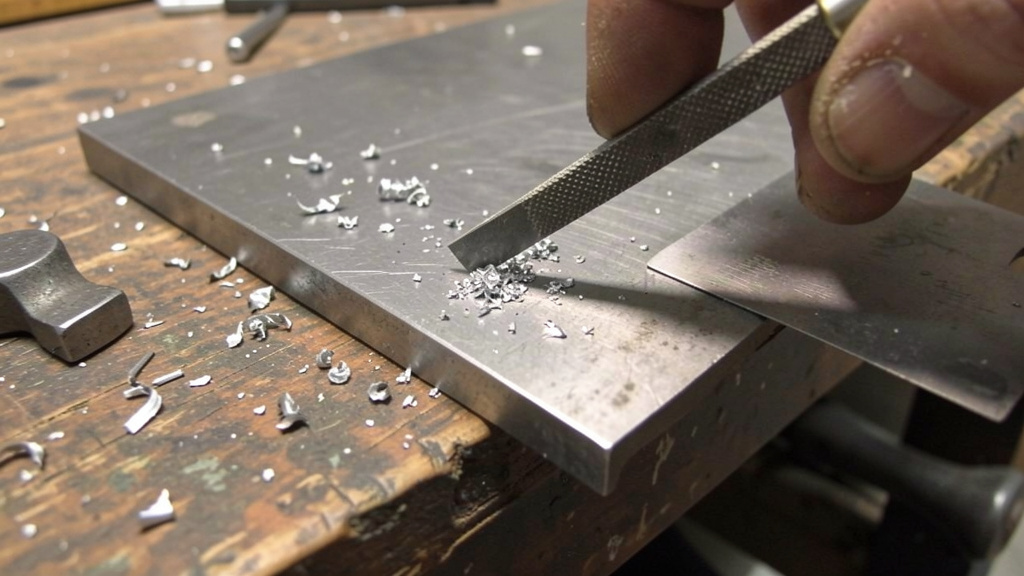
– Post-cut necessity: Always deburr edges. A file removes sharp slivers; a dedicated deburring tool creates a slight chamfer. Why? Sharp edges pose handling hazards and act as stress concentrators under load.
– Nuance: Use a mill bastard file (medium cut) for steel; smoother second-cut file for final smoothing. For aluminum, select a file with a “safe edge” (one smooth side) to protect adjacent surfaces.
Method 2: Power Saws for Efficiency and Repetition
Ideal for straight cuts, thicker stock (1/8″–1″), or multiple identical pieces.
Bandsaw:
– Blade selection: Tooth pitch approximately 1.5x material thickness. For 1/4″ steel: 14 TPI blade. For 1″ steel: 6 TPI. Bi-metal blades offer significantly longer life than carbon steel. Coolant note: Light cutting oil spray reduces heat and extends blade life for frequent use.
– Setup essentials: Adjust blade guides 1/16″ above workpiece. Verify proper tension (minimal deflection when pressed). Set speed per manufacturer chart: slower for steel, faster for aluminum.
– Common error: Forcing the cut causes blade drift or breakage. Let the blade cut at its natural pace. If speed drops noticeably, reduce feed pressure.
– Adaptive path: Entry-level 4×6 bandsaws, upgraded with quality blades and guides, handle most DIY needs. In professional settings, bandsaws are favored for structural cuts due to minimal heat-affected zone (HAZ), beneficial for subsequent welding.
Chop Saw (Abrasive or Cold Cut):
– Abrasive chop saws: Use fiber-reinforced cutoff wheels. Best for rough cuts where edge quality is secondary (e.g., rebar for garden edging). Generates significant heat/sparks—full PPE required. Wheels can shatter if bent; never force the cut.
– Cold cut saws: Use toothed blades, often with coolant or dry-cut technology. Produce clean, square, cool edges ready for joining. Worth considering for frequent metal cutting.
– Safety note: Abrasive wheels have expiration dates. Store vertically, inspect for cracks before use, and perform a brief test run behind the guard.
Reciprocating Saw (“Sawzall”):
– Appropriate use: Demolition, cutting pipes in confined spaces, irregular shapes. Not ideal for precision work.
– Blade selection: “Demolition” blades (fewer teeth) for thick steel; “metal cutting” blades (more teeth) for sheet metal. Clamp workpiece firmly to manage vibration. Cutting at a slight angle can reduce binding.
– Practical tip: Attach cardboard to the shoe to prevent marring finished surfaces. For flush cuts against walls, use blades with offset teeth.
Method 3: Abrasive and Thermal Methods for Demanding Tasks
Ideal for thick plate (>1/2″), complex curves, demolition, or constrained access.
Angle Grinder with Cutoff Wheel:
– Wheel selection: Type 1 (flat) for straight cuts; Type 27 (depressed center) for better visibility. Thickness: 1/16″ for thin metal (faster cut); 1/8″ for thick stock (less flex). Critical: Use only wheels rated for your grinder’s RPM. Never modify guards.
– Technique: Hold grinder at 15–30 degrees to the workpiece. Apply light pressure—let the wheel cut. For long cuts, make relief cuts to prevent binding. Always cut away from your body.
– Safety emphasis: Cutoff wheels can fail at high RPM. Wear face shield and safety glasses. Secure the workpiece to prevent rotation. Inspect wheels for damage; a “ring” when tapped indicates integrity, a “thud” suggests cracks.
– Contextual example: Removing a rusted bolt head from a gate hinge. The grinder’s compact size accesses tight spaces where a hacksaw would bind. Alternative: Bolt extractor if threads are accessible—but cutoff may be faster for surface bolts.
Plasma Cutter:
– Process overview: Compressed gas and electrical arc create a plasma jet that melts metal. Requires clean, dry air supply.
– Amperage consideration: Lower amperage units (20A) handle thin steel; higher amperage (40A+) cuts thicker material. Important: Correct amperage setting prevents dross (re-solidified slag) or excessive kerf width.
– Technique: Hold torch perpendicular. Start cuts at the edge. Maintain steady travel speed. Magnetic guides assist with circles.
– Accessibility note: Entry-level plasma cutters handle common DIY thicknesses. Rental is viable for one-off projects. Clarification: Plasma can cut painted or lightly rusted metal, but clean surfaces yield better results and extend consumable life. Always remove heavy rust first.
– Environmental consideration: Generates UV radiation and fumes. Use in well-ventilated areas with appropriate respiratory protection. Avoid cutting galvanized steel without proper respiratory safeguards due to zinc fume risks.
Oxy-Acetylene Torch:
– Appropriate scenarios: Cutting very thick steel (>1″), heating/bending metal, or locations without electricity. Cannot cut stainless steel or aluminum effectively, as the process relies on iron oxide formation.
– Safety priority: Acetylene requires careful handling. Use regulators set to recommended pressures. Check hoses for leaks with soapy water before each use. Store cylinders secured upright.
– Ignition sequence: Purge lines briefly. Light acetylene first (yellow flame), then add oxygen to achieve a neutral flame (sharp blue cone). Engage oxygen jet for cutting.
– Context: Plasma technology has largely superseded torch cutting for general DIY due to speed and cleanliness. Torches remain valuable for heavy fabrication, salvage, or artistic heating. Recommendation: Seek hands-on instruction before attempting.
Method 4: Shearing and Nibbling for Sheet Metal Work
Ideal for clean straight or curved cuts in thin sheet metal (up to 16-gauge steel, 1/8″ aluminum).
Bench Shear (Throatless Shear):
– Advantage: Cuts curves and straight lines without contacting one side of the material—useful for internal cutouts. Minimal sparks or burr.
– Technique: Mark the cut line clearly. Feed metal steadily; avoid forcing. Make relief cuts for tight curves. Deburr edges afterward.
– Limitation: Capacity varies by model. Verify specifications for material type and thickness.
Electric Nibbler:
– Function: Punches overlapping small holes, ejecting slugs. Creates a narrow kerf with minimal distortion.
– Best applications: Cutting openings in sheet metal (e.g., for electrical boxes), following complex templates. Available as drill attachments or standalone units.
– Tip: Clamp scrap wood behind the metal to reduce vibration and improve edge quality. Collect ejected slugs—they are sharp.
Cutting Selection Guide: Aligning Method to Project Needs
| Project Scenario | Recommended Method | Rationale | Tool Considerations |
|---|---|---|---|
| Cutting 1/8″ steel brackets for shelf | Hacksaw or bandsaw | Clean edge, minimal heat, precise length control | 32 TPI hacksaw blade; 14 TPI bi-metal bandsaw blade |
| Trimming aluminum flashing for garden bed | Aviation snips (green/red) | Fast, no power needed, follows curves easily | Compound-action snips reduce hand fatigue |
| Cutting 1/2″ steel pipe for trellis legs | Angle grinder with cutoff wheel | Accessible in tight spaces, efficient | 4.5″ grinder, 1/16″ cutoff wheel rated for RPM |
| Demolishing rusted steel gate | Reciprocating saw or plasma cutter | Handles corrosion, speed in demolition | Metal-cutting blade; plasma cutter sized for thickness |
| Cutting intricate leaf pattern in 20-gauge steel | Bench shear or nibbler | Clean curves without distortion or heat | Throatless shear for curves; nibbler for internal cutouts |
| Cutting 3/4″ thick steel plate for base | Plasma cutter (60A+) or oxy-fuel | Methods capable of clean, controlled thick cuts | Industrial plasma unit; properly maintained oxy-fuel rig |
Essential Cutting Safety Practices
- Eye protection is essential: Sparks travel at extreme temperatures. ANSI Z87.1+ glasses worn under a face shield provide layered defense.
- Secure the workpiece: Use C-clamps, vises, or welding magnets. Never hold metal near the cutting path.
- Pre-use inspection: Check cords, guards, wheels, and blades. Stop work immediately if damage is found.
- Fire awareness: Keep sand bucket or extinguisher nearby. Sparks can ignite residues hours later.
- Ventilation awareness: Cutting coated metals releases fumes. Work outdoors or with active exhaust when possible.
Addressing Common Cutting Challenges
- Blade binds mid-cut: Release pressure. Verify workpiece stability and material flatness. For bandsaws, check blade tension and guide alignment. For hacksaws, ensure frame alignment.
- Jagged edges on sheet metal: Increase TPI (more teeth), reduce feed pressure, ensure full material support to minimize vibration. For snips, use compound-action tools and cut deliberately.
- Heat discoloration (straw/blue tints): Reduce feed rate. Apply cutting fluid (for saws) or increase travel speed (for thermal methods). Discoloration may indicate work-hardening; affected areas may require grinding before joining or coating.
- Cutoff wheel failure: Stop immediately. Causes include expired/damaged wheels, RPM mismatch, or impact. Inspect grinder guard integrity before resuming. Always wear full face protection.
Joining Metal: Creating Durable, Purpose-Appropriate Connections
Joining defines structural integrity. A compromised joint fails without warning—unlike wood, which may show gradual signs. This section clarifies metallurgical bonding principles, emphasizing why certain methods suit specific scenarios. Strength depends on correct application, not just the method chosen.
Understanding Joining Principles: Fusion, Mechanical, and Adhesive
- Fusion Joining (Welding/Brazing): Creates atomic-level bonds by melting base metal (welding) or filler only (brazing). Introduces a heat-affected zone (HAZ) where material properties change. Key insight: Welding dissimilar metals (e.g., steel to aluminum) is challenging due to differing melting points and expansion rates; brazing often succeeds where welding struggles.
- Mechanical Joining (Fasteners/Rivets): Uses physical force. No heat = no HAZ. Allows disassembly. Strength depends on fastener quality, hole precision, clamping force, and material compatibility. Nuance: Bolted joints can distribute stress effectively in dynamic applications (e.g., trailer frames).
- Adhesive Joining: Modern structural adhesives bond at a molecular level. Excels on thin metals where heat causes distortion. Requires meticulous surface preparation. Often used alongside mechanical fasteners for redundancy.
Method 1: Welding – For Permanent, High-Strength Bonds
Note: Welding requires practice and safety awareness. Begin on scrap material. Exercise caution with coated metals—zinc fumes from galvanized steel require respiratory protection.
MIG Welding (GMAW): Accessible for Learning
– Process: Continuous wire electrode fed through gun, shielded by gas. Semi-automatic—user controls speed and angle.
– Setup considerations:
– Gas: 75% Argon / 25% CO2 (C25) for steel. Pure argon for aluminum (requires spool gun).
– Wire: ER70S-6 for mild steel. Diameter: .023″ for thin metal (<1/8″); .030″ general purpose; .035″ for thicker stock.
– Settings: Begin with machine chart. Test on scrap: a consistent “sizzling” sound and uniform bead indicate good settings. Too hot risks burn-through; too cold causes weak fusion.
– Technique:
1. Clean joint area to bare metal (grind within 1″ of seam).
2. Clamp pieces tightly—gaps weaken joints.
3. Hold gun at 10–15 degrees travel angle, 1/4″ from work.
4. Pull technique (drag gun) generally offers better penetration for steel. Push technique creates wider beads—useful for thin metal or aluminum.
5. Maintain steady travel speed. Bead width should be consistent.
– Common learning points:
– Excessive stick-out reduces gas coverage → porous welds.
– Verify polarity per machine manual (typically DCEN for MIG).
– Cleanliness is critical—contaminants cause spatter and weakness.
– Adaptive path: Used MIG welders offer capable entry points. Rental allows skill assessment before purchase. Consistent practice on scrap builds muscle memory.
TIG Welding (GTAW): Precision for Critical or Visible Joints
– When appropriate: Stainless steel, aluminum, thin metals (<1/8″), or applications requiring clean, aesthetic welds. Slower process with exceptional control.
– Requirements: Foot pedal for amperage control, non-consumable tungsten electrode, separate filler rod. Demands hand-eye coordination.
– Gas sensitivity: 100% argon for steel/stainless; argon/helium mixes for aluminum. Even light breezes disrupt shielding—use wind barriers.
– Value proposition: Produces clean, spatter-free welds requiring minimal cleanup. Ideal for food-contact surfaces or artistic work. Consideration: Learning curve is significant. Instructional classes accelerate proficiency. May not be cost-effective for simple structural brackets.
Stick Welding (SMAW): Rugged for Field Conditions
– Strengths: No shielding gas needed (flux-coated rod creates protection). Tolerates wind, dirt, and rust better than wire processes. Highly portable.
– Limitations: Slag removal required. Less ideal for very thin metal. Rods can stick with inconsistent technique.
– Rod selection: 6013 = general purpose, forgiving arc. 7018 = higher strength, low-hydrogen (for critical joints), often requires storage in a rod oven.
– Technique: Strike arc like a match. Maintain arc length approximately equal to rod diameter. Slight weave for wider joints. Chip slag after cooling.
– Practical relevance: Excellent for farm repairs, gate hinges, or outdoor projects where portability and environmental tolerance matter. Simple, durable machines have long service lives.
Method 2: Brazing and Soldering for Lower-Heat Applications
Distinction: Soldering occurs below 840°F (filler melts, base metal does not); Brazing occurs above 840°F (stronger joints). Both rely on capillary action—filler flows into tight gaps.
Brazing (Oxy-Acetylene or Torch):
– Ideal scenarios: Joining dissimilar metals (steel to copper), thin sections, or situations requiring minimal heat distortion (e.g., cast iron repair).
– Process:
1. Clean joint surfaces thoroughly (acetone wipe recommended).
2. Apply flux to prevent oxidation during heating.
3. Heat both pieces evenly until flux becomes active.
4. Touch filler rod (bronze or silver alloy) to the joint—not the flame. Capillary action draws it in.
5. Allow to cool gradually; rapid quenching may cause cracks.
– Strength note: Properly executed brazed joints can exceed the strength of the base metals. Silver alloys offer high strength but at greater cost.
– Application example: Repairing a cast iron stove leg. Brazing’s lower heat reduces thermal shock risk compared to welding.
Soldering:
– Context matters: Rosin-core solder for electronics; acid-core flux for metalwork (plumbing, automotive). Never substitute acid-core solder in electronics.
– Metalworking use: Sealing copper gutter seams, attaching brass plates. Requires tight-fitting joints (<0.005″ gap).
– Tip: A propane torch with a soldering copper tip offers better heat control for small jobs. Clean joint surfaces with a wire brush first.
Method 3: Mechanical Fastening – Strength, Reversibility, No Heat
Often underestimated, mechanical joints offer reliability, serviceability, and no thermal distortion. Engineering details matter.
Bolting Best Practices:
– Hole precision: Drill pilot holes slightly undersized relative to bolt diameter (e.g., 15/64″ hole for 1/4″ bolt). A drill press ensures perpendicular holes. Counterbore for flush heads.
– Clamping force: Torque wrenches ensure consistent pressure. Under-torquing risks loosening; over-torquing strips threads. Consult torque charts for bolt grades.
– Corrosion awareness: Avoid direct contact between dissimilar metals (e.g., steel bolts in aluminum). Use insulating nylon washers or sleeves. Anti-seize compound aids future disassembly.
– Engineering insight: In applications with vibration or cyclic loading, bolted connections can offer fatigue resistance advantages. For a backyard bench, properly engineered bolts may provide longer service life than a marginal weld.
Riveting:
– Pop Rivets (Blind Rivets): Install from one side—ideal for attaching brackets inside enclosures. Match rivet material to base metal (aluminum rivets for aluminum). Verify grip range matches material thickness.
– Solid Rivets: Require access to both sides. Set with hammer and bucking bar. Stronger than pop rivets. Common in aerospace (“aircraft rivets”).
– Technique: Drill precise hole. Insert rivet. For pop rivets, pull gun until stem snaps cleanly. For solid rivets, heat to cherry-red (if applicable), insert, and form the shop head.
Self-Tapping Screws:
– Appropriate use: Attaching thin sheet metal to wood or frames (e.g., metal roofing). Not recommended for structural metal-to-metal joints.
– Critical steps: Use screws designed for metal (sharp point, coarse threads). Pre-drill pilot holes slightly smaller than thread diameter.
– Failure mode: Over-tightening strips threads. Use a screwdriver with adjustable clutch set to low torque.
Method 4: Adhesive Bonding for Specialized Needs
Modern structural adhesives can rival mechanical strength when surface preparation and application are meticulous.
Epoxy Systems:
– Surface prep is critical: Abrade to bright metal. Clean thoroughly with acetone. Apply primer if specified by manufacturer.
– Mixing precision: Adhere strictly to mix ratios (e.g., 1:1, 2:1). Mix thoroughly for full duration on a disposable surface, scraping sides.
– Clamping: Apply even pressure. Respect cure times (30 minutes to 24+ hours). Avoid disturbing during cure.
– Best applications: Bonding dissimilar metals, non-structural crack repairs, or where vibration damping is beneficial.
Methacrylate Adhesives (e.g., Plexus-type):
– Advantage: Tolerates slightly oily or less-than-perfect surfaces better than epoxies. Faster cure profiles available.
– Typical uses: Marine fittings, automotive trim attachment.
– Precaution: Strong fumes—use in well-ventilated areas with appropriate respiratory protection.
Joining Method Selection Guide
| Joint Requirement | Recommended Approach | Rationale | Key Consideration |
|---|---|---|---|
| Structural handrail (outdoor) | MIG welding + grinding | Permanent, high strength, weather-resistant when finished | Grind weld smooth; apply rust-inhibiting primer promptly |
| Aluminum garden sculpture | TIG welding or mechanical bolts | Minimizes heat distortion; TIG welds aluminum cleanly | If bolting, use stainless hardware with insulating washers |
| Repairing cast iron bench leg | Brazing | Lower heat reduces cracking risk in brittle material | Preheat entire piece gradually; cool slowly |
| Attaching steel bracket to wooden post | Self-tapping screws (metal-to-wood) | Simple, reversible, no welding required | Pre-drill wood; use corrosion-resistant screws |
| Joining copper pipe to steel tank | Silver brazing | Accommodates dissimilar metals; creates sealed joint | Ensure flux compatibility; clean thoroughly after |
| Temporary workshop jig | Clamps or welding magnets | Zero permanent alteration; quick setup/teardown | Magnets work only on ferrous metals |
Welding Walkthrough: Simple Bracket Example
Project: Joining two 1/8″ mild steel brackets at 90 degrees for shelf support.
- Preparation (Critical Phase):
- Grind mating surfaces to bare, clean metal within 1″ of the joint line. Remove all rust, paint, oil.
- Clamp brackets firmly in a vise or jig at precisely 90 degrees. Verify with a square. Gap should be minimal (<1/16″).
-
Don full PPE: auto-darkening helmet (shade #10), flame-resistant clothing, leather gloves, safety glasses.
-
Equipment Setup:
- Wire: .030″ ER70S-6
- Gas: C25 (75% Ar / 25% CO2)
- Settings: Begin with machine chart recommendations for material thickness (e.g., ~18V, 150 IPM).
-
Test on scrap steel of identical thickness. Adjust until bead is consistent with minimal spatter.
-
Welding Execution:
- Start at the top of the vertical bracket. Strike the arc.
- Hold gun at 15 degrees toward direction of travel (pull technique).
- Maintain consistent 3/8″ stick-out (wire tip to work).
- Move steadily downward. Speed should produce a bead width of approximately 1/4″.
- Stop before the very end; restart 1/4″ back to avoid crater cracks.
-
Weld both sides of the joint for balanced strength and reduced warp.
-
Post-Weld Steps:
- Allow to cool briefly. Remove slag if applicable (stick welding).
- Grind weld smooth using a flap disc on an angle grinder. Feather edges into base metal.
- Wipe clean with acetone. Apply rust-inhibiting primer within a few hours to prevent flash rust.
Why this sequence works: Clean surfaces ensure fusion. Proper settings prevent burn-through on thin material. Welding both sides balances heat input. Prompt priming protects the vulnerable heat-affected zone.
Preventing Common Joining Issues
- Warping Mitigation:
- Clamp aggressively.
- Use skip welding: Weld a short section, skip a space, weld the next section. Allows heat dissipation.
- For long seams, alternate welding sides.
-
Note: Correcting significant warp is difficult; prevention is far more efficient.
-
Weak Joint Indicators:
- Incomplete penetration: Review amperage and travel speed.
- Contamination: Cleanliness cannot be overstated—oil causes porosity.
- Poor fit-up: Gaps require specialized techniques.
-
Verification: Visual inspection per AWS D1.1 guidelines is standard for non-critical work. For critical structural items, professional evaluation is recommended.
-
Galvanic Corrosion Prevention:
- Isolate dissimilar metals using non-conductive washers or sleeves.
- Apply barrier coatings (e.g., zinc-rich primer) to the more anodic metal.
- In harsh environments (marine), consider sacrificial anodes.
Finishing Metal: Preservation Through Purposeful Process
A beautifully joined bracket left unprotected outdoors will deteriorate rapidly. Finishing is metallurgical defense—not merely aesthetics. This phase demands the same rigor as cutting or joining. Rushing here undermines all prior effort.
The Imperative of Finishing: Understanding Corrosion
Corrosion begins quickly on exposed freshly cut or welded metal. Moisture and oxygen initiate reactions that accelerate with each cycle of flaking. Stainless and aluminum form protective oxides, but scratches, weld seams, or embedded particles create vulnerable sites. Contextual note: Service life varies significantly with environment. Coastal, industrial, or high-humidity settings demand more robust systems. Proper finishing dramatically extends functional life compared to bare metal.
Step 1: Cleaning and Deburring – The Non-Negotiable Foundation
Coatings fail first at sharp edges or contamination points. Never skip this phase.
Deburring Options:
– Files: Effective for small brackets. Use a mill bastard file at a 45-degree angle to create a slight chamfer.
– Dedicated deburring tools: Efficient for straight edges—removes burr and chamfers in one pass.
– Wire brushes: Cup brushes (on angle grinder) for weld seams; hand brushes for corners. Critical: Use brushes dedicated to specific metals (e.g., “STAINLESS ONLY” labeled) to avoid cross-contamination.
– Sandpaper: Start coarse (80 grit) on rough areas, progress to 120 grit. Use a sanding block for flat edges.
Cleaning Protocol:
1. Remove loose debris with a stiff brush.
2. Degrease: Wipe with acetone or denatured alcohol on a lint-free cloth. Acetone evaporates cleanly without residue.
3. For rust or heavy oxidation: Phosphoric acid-based converters (e.g., Naval Jelly) can stabilize surfaces—follow product instructions carefully.
4. Final wipe: Clean cloth dampened with acetone. Handle cleaned parts with gloves to avoid salt/oil transfer from skin.
Critical reminder: Painting over mill scale (the dark oxide on hot-rolled steel) commonly leads to premature adhesion failure. Grinding to bright metal is essential for lasting results on such surfaces.
Step 2: Surface Smoothing for Optimal Adhesion
Goal: Create uniform texture (“tooth”) for coating mechanical bonding. Mirror polish is unnecessary and may reduce adhesion.
Sanding Progression:
– Start: 80 grit for weld seams or deep scratches. Sand with the metal grain if visible.
– Middle: 120 grit to remove previous scratches.
– Finish: 180–220 grit for primer adhesion. Stop here for most functional projects. Higher grits (320+) are for decorative polish but may reduce coating grip.
– Tool note: Random orbital sanders minimize swirl marks. Sanding sponges or folded paper work well for corners.
Smoothing Welds:
– Use a flap disc (not a grinding wheel) on an angle grinder for controlled material removal.
– Technique: Light pressure, keep moving. Grind parallel to the weld bead first, then cross-grain to blend smoothly.
– Check: Run a gloved finger over the area—transition to base metal should feel seamless, without ridges or pits.
Polishing (Decorative Applications Only):
– Stainless steel: Use compounds and wheels dedicated solely to stainless. Cross-contamination causes surface rust.
– Aluminum: Progress from 120 grit to 400 grit wet/dry paper. Finish with aluminum polish.
– Important: Polishing removes the natural oxide layer. Seal immediately with clear coat or wax to prevent rapid re-oxidation.
Step 3: Protective Coating Application
Coating choice depends on metal type, environment, and desired appearance. Technique is as vital as product selection.
Paint Systems:
– Primer is essential: Zinc-rich (inorganic) primers offer maximum corrosion resistance. Etching primers (phosphoric acid-based) improve adhesion on challenging metals like aluminum. Never substitute wood primers.
– Topcoat options:
– Oil-based enamel: Durable, slower drying.
– Acrylic latex: Faster dry, lower VOCs—use metal-specific formulas.
– Epoxy paint: Excellent chemical/abrasion resistance for workshops.
– Application method:
1. Stir primer gently (avoid shaking to prevent bubbles).
2. Apply thin, even coat. Pay special attention to edges and corners—corrosion initiates at thin spots.
3. Dry per manufacturer instructions (typically 1–4 hours).
4. Lightly sand with 220 grit (“scuff sanding”) to promote topcoat adhesion.
5. Apply topcoat. Two thin coats generally outperform one thick coat (reduces runs).
6. Allow full cure time (24–72 hours) before use. Humidity and temperature affect cure.
Powder Coating: Durable Finish with DIY Pathways
– Process: Electrostatically charged powder adheres to grounded metal, then cured in an oven (350–400°F) to form a seamless, durable layer.
– DIY feasibility: Small items (brackets, tools) can be powder coated at home.
– Powder coating gun ($150–$400).
– Dedicated oven (e.g., toaster oven—never use a kitchen oven due to fume hazards).
– Process: Clean metal thoroughly → apply powder → bake per powder instructions → cool.
– Advantages: No VOCs, thick uniform coating, excellent chip resistance.
– Limitations: Color changes require thorough gun cleaning. Large items need commercial services.
– Tip: Practice on scrap first. Ensure excellent grounding—clean a small spot for the clip contact.
Clear Coatings for Bare Metal Aesthetics:
– Wax: Renaissance Wax or paste wax. Apply thin layer, buff. Reapply annually. Suitable for indoor decorative pieces.
– Lacquer: Clear acrylic lacquer (spray). Protects polished aluminum or brass. Reapply every 1–2 years.
– Oil finishes: Boiled linseed oil (BLO) on steel creates a dark patina. Wipe on, wait 15 minutes, wipe off excess. Repeat 2–3 times. Critical safety: Oil-soaked rags can self-ignite—lay flat to dry outdoors completely before disposal.
– Best for: Indoor art, tool restoration, where an “aged metal” appearance is desired.
Material-Specific Finishing Guidance
Mild Steel:
– Outdoor: Zinc-rich primer → two coats of exterior enamel. Powder coating offers maximum longevity.
– Indoor: Primer → enamel, or clear wax for industrial aesthetic.
– Timing note: Complete priming within a few hours of final sanding to minimize flash rust, especially in humid conditions.
Stainless Steel:
– Clarification: “Stainless” is not maintenance-free. Weld seams and scratches require attention.
– Process: Clean with stainless-specific cleaner. Remove heat tint (rainbow colors from welding) with pickling paste if desired. Apply stainless polish. For harsh environments, a clear acrylic lacquer adds protection.
– Tool discipline: Maintain separate brushes, sandpaper, and rags labeled for stainless use only.
Aluminum:
– Challenge: Forms oxide layer rapidly after abrasion, potentially reducing paint adhesion.
– Solution: Sand to 180 grit → wipe with acetone → apply etching primer promptly → topcoat.
– Alternative: Professional anodizing creates durable colored finishes. DIY kits exist but require precision.
– For bare look: Clear acrylic lacquer prevents white oxidation (“white rust”).
Achieving Quality Finishes with Limited Resources
- No spray booth? Spray outdoors on a calm day. Suspend parts from wire between sawhorses. Use a cardboard shield for wind.
- No sandblaster? Manual sanding with patience. For rust removal, an electrolysis tank (battery charger, washing soda, plastic tub) is effective and low-cost.
- Primer alternative: For indoor, non-critical items, self-etching primer in aerosol form works adequately.
- Pro technique: “Wet sanding” primer: Lightly sand with 320 grit paper dampened with water to remove dust nibs for a smoother topcoat.
Troubleshooting Common Finish Issues
-
Paint peeling at edges:
Cause: Inadequate edge preparation or insufficient coating coverage.
Solution: Deburr edges thoroughly before priming. “Feather” edges with sandpaper. Apply extra primer to edges during coating. -
Orange peel texture on spray finish:
Cause: Paint viscosity too high, low temperature, or incorrect spray distance.
Solution: Thin paint per instructions. Warm can slightly (not excessively). Hold 8–10″ from surface. Apply light, even mist coats. -
Rust spots appearing under paint:
Cause: Incomplete cleaning—residual oil, mill scale, or salts remained.
Solution: Strip completely. Grind to bright metal. Degrease meticulously. Apply appropriate primer immediately. -
Powder coat bubbling during cure:
Cause: Moisture or oil trapped under the powder.
Solution: Pre-bake parts at 200°F for 10 minutes before powder application to drive out moisture. Ensure surfaces are immaculately clean.
Navigating Setbacks: A Systematic Approach to Project Challenges
Even experienced metalworkers encounter obstacles. Progress comes from methodical problem-solving, not frustration. This section addresses common friction points with practical, safety-conscious solutions.
The Repair Mindset: Assess, Adapt, Learn
Metal is less forgiving than wood, but many issues are correctable. Ask:
– Is structural integrity compromised? (e.g., cracked weld on a load-bearing joint requires redo; a cosmetic scratch may only need polishing).
– Can the design be adapted? (Cut too short? Add a gusset plate. Misaligned hole? Drill oversize and use a bushing).
– What was the root cause? Address the cause to prevent recurrence.
Industry practice: Many workshops maintain informal logs of common issues (e.g., “porosity due to draft,” “hole misalignment from layout error”). Documenting builds collective knowledge.
Addressing Common Project Challenges
Challenge: “I cut the metal too short.”
– Immediate step: Assess if the piece can be repurposed. Measure remaining stock—can the design be adjusted?
– Repair path: For structural elements, weld an extension plate (gusset) with adequate overlap. For non-structural items, file the edge smooth and incorporate the asymmetry into the design.
– Prevention strategy: Adopt “measure twice, cut once.” Mark cut lines with a center punch. Cut outside the line; file to final dimension. For critical dimensions, cut and test-fit one piece before proceeding.
Challenge: “My weld appears weak or uneven.”
– Diagnosis: Grind off the weld. Inspect the base metal:
– Burn-through? → Excessive heat or slow travel speed.
– Cold lap (bead sitting on surface)? → Insufficient heat, fast travel, or contamination.
– Porosity (tiny holes)? → Draft disrupting gas shield, contaminated gas, or oily metal.
– Corrective action: Clean area thoroughly. Adjust settings. Practice on scrap. Re-weld with refined technique.
– When to restart: If base metal is significantly warped or cracked from overheating, cut out the section and splice in new material. A sound repair is preferable to reinforcing a weak area.
Challenge: “Rust appeared quickly after sanding.”
– Cause: “Flash rust” from humidity reacting with freshly exposed iron—common in coastal areas or high humidity.
– Response: Lightly sand affected area with fine grit (220). Wipe with a rust converter if available, then apply primer immediately.
– Prevention: Have primer and cleaning supplies ready before final sanding. Work in a climate-controlled space when possible. Consider rust-inhibiting sprays that leave a temporary protective film.
Challenge: “Paint failed after one season.”
– Root cause analysis:
– Peeling at edges? → Inadequate edge preparation.
– Blisters? → Moisture trapped under coating.
– Uniform failure? → Insufficient cleaning or incorrect primer.
– Solution: Strip completely. Restart with rigorous cleaning and surface prep. For demanding outdoor use, upgrade to a powder coating system or marine-grade paint system.
– Key insight: Thorough surface preparation saves significant time and materials long-term. Skipping prep risks complete redo.
Recognizing When to Seek Professional Assistance
Know your boundaries. Safety and structural integrity warrant expert involvement:
– Critical structural loads: Stair railings, deck supports, vehicle frames. Certified welders ensure joints meet engineering and code requirements.
– Hazardous materials: Galvanized steel (zinc fume risks), lead-painted metal, or specialized alloys. Industrial ventilation and training are essential.
– Complex metallurgy: Cast iron machinery repair, welding dissimilar thick metals, heat treatment of hardened steel.
– Regulatory compliance: Projects requiring certified welding procedures (e.g., pressure vessels, architectural elements per building codes).
Finding support: Search for “AWS Certified Welder” or local fabrication shops. Many offer consultation or small-job services. The investment in professional help is minor compared to risks of injury or project failure.
Your Questions, Answered
Q: What is the safest starting point for a complete beginner to practice cutting metal?
A: Begin with hand tools on thin, non-structural material. Use aviation snips on 24-gauge steel sheet (such as HVAC duct scrap) to cut simple shapes. Wear ANSI Z87.1+ safety glasses and cut-resistant gloves. This builds spatial awareness and tool control without sparks, high noise, or significant risk. Progress to a hacksaw on 1/8″ steel rod once comfortable. Delay power tool use until workpiece securing and tool handling feel intuitive.
Q: Can standard MIG welders effectively weld aluminum?
A: Standard MIG welders designed for steel face challenges with aluminum. Aluminum wire is soft and prone to feeding issues in standard liners. Successful aluminum MIG welding typically requires a spool gun (to shorten the feed path), 100% argon shielding gas, and a Teflon liner. For occasional DIY aluminum projects, TIG welding offers more reliable results but has a steeper learning curve. For many beginners, mechanical fastening with stainless hardware and insulating washers provides a safer, stronger solution than attempting a marginal weld.
Q: How can I assess if a weld is sufficiently strong for a non-critical backyard project?
A: For non-structural items like garden trellises or decorative brackets, visual inspection provides useful insight: the weld should appear uniform, slightly convex, and blend smoothly into the base metal without visible cracks, porosity, or undercut. Tapping lightly with a hammer may produce a clear ringing sound, suggesting sound fusion—though this is not a definitive test. For any load-bearing application (handrails, structural supports), consult engineering guidelines or engage a qualified professional. When uncertain, reinforce with gusset plates or mechanical fasteners.
Q: Is it accurate that wire brushes should never be used on stainless steel?
A: Wire brushes can be used on stainless steel, but only if the brush is dedicated exclusively to stainless steel and clearly labeled. Carbon steel bristles embed particles into the stainless surface, leading to surface rust (“rouging”). For optimal results, use nylon abrasive brushes or non-metallic abrasives specifically designed for stainless steel preparation.
Q: What is the most economical effective method to protect outdoor metal furniture from rust?
A: Rigorous surface preparation followed by zinc-rich primer and two coats of quality exterior enamel offers strong protection at low cost. Estimated materials: sandpaper/acetone ($15), primer ($20), paint ($25). Total under $60 for a bench. Skipping prep leads to premature failure, increasing long-term cost. For a very low-budget option: Boiled linseed oil (BLO) creates a dark protective patina. Apply 2–3 thin coats, wiping excess each time. Reapply annually. Critical safety: Lay BLO-soaked rags flat outdoors to dry completely before disposal to prevent spontaneous combustion.
Q: Why does my angle grinder sometimes kick back during cutting?
A: Kickback typically occurs when the cutoff wheel binds or catches. Common causes include forcing the cut, using a dull or damaged wheel, improper guard positioning, or workpiece movement. Solutions: Use a sharp, undamaged wheel rated for the grinder’s RPM; secure the workpiece firmly; apply light, consistent pressure; ensure the guard is correctly positioned between you and the wheel; always cut away from your body. If kickback persists, stop immediately—inspect the tool, wheel, and setup before continuing.
Q: Is it possible to powder coat over existing paint?
A: No. Powder coating requires direct adhesion to clean, contaminant-free metal. Existing paint, rust, oil, or residues will cause bubbling, peeling, or poor adhesion during the curing process. Strip the item completely using sandblasting, chemical stripper, or thorough sanding to bright metal. Clean meticulously with acetone before powder application. Attempting to coat over existing finishes guarantees failure.
Q: How can deep rust be removed from thin or delicate metal items without causing damage?
A: Electrolysis is a gentle, effective method for thin or intricate items. Setup: Submerge the rusty item (cathode) in a plastic tub of water mixed with washing soda (approximately 1 tablespoon per gallon). Suspend a sacrificial steel scrap (anode) nearby without touching. Connect the negative terminal of a battery charger to the rusty item, positive to the scrap. Bubbles will form—rust converts to a black oxide over 12–24 hours. Rinse thoroughly, scrub lightly with a brush, and prime immediately. This method removes rust without damaging the underlying metal, unlike aggressive sanding or acids.
Q: What distinguishes brazing from welding when repairing cast iron?
A: Welding cast iron carries a high risk of cracking due to its brittleness and sensitivity to rapid temperature changes. Brazing uses significantly lower temperatures (typically 1,100–1,500°F versus 2,500°F+ for welding), minimizing thermal shock. The brazing filler (often bronze) flows into the joint via capillary action without melting the base metal. For DIY repairs on cast iron, brazing is generally more reliable. Preheating the entire piece gradually (e.g., to 500°F) and allowing it to cool slowly (e.g., buried in sand) further reduces cracking risk.
Q: Is grounding essential when powder coating?
A: Yes. Powder coating relies on electrostatic attraction—the powder particles carry a charge, and the grounded metal part attracts them. Without a solid electrical connection to bare metal, powder adhesion will be uneven or poor. Clean a small spot on the part, attach the grounding clip directly to bare metal, and verify continuity if possible. This step is fundamental to the process.
Conclusion and Your Immediate Next Step
Metalworking mastery develops through layered understanding. You now have a framework where safety informs every action, process decisions align with material and project needs, and finishing ensures longevity. Remember the century-old gate—not crafted with exotic tools, but with respect for material, adherence to fundamentals, and protection against the elements. Your creations can embody that same enduring quality.
The Three Pillars Revisited
- Safety Foundation: PPE, workspace protocols, and tool safeguards are non-negotiable prerequisites.
- Process Precision: Technique selection based on metal type, project demands, and personal constraints replaces guesswork with confidence.
- Finish Integrity: Cleaning, deburring, and coating are integral to the project—not optional final steps. Unprotected metal is incomplete work.
The 24-Hour Action: Build Safety Awareness
Within the next day, complete this focused safety check:
🔍 Workspace Safety Snapshot:
1. Verify your fire extinguisher is accessible and the pressure gauge indicates readiness.
2. Confirm your safety glasses display the ANSI Z87.1+ marking.
3. Inspect tools for damaged cords, compromised guards, or other visible issues.
Why this matters: Safety habits form through consistent, small actions. This brief audit cultivates proactive awareness without overwhelm. Note any items needing attention and address them before your next project. This simple act reinforces a culture of safety more effectively than any advanced technique.
The Enduring Value of Metalworking
Each smoothed edge, each sound joint, each protected surface builds tangible competence. Metal teaches patience and precision—respect its properties, and it rewards with permanence. Begin modestly: fabricate a single shelf bracket, applying every step from layout to final coating. Experience the progression from raw material to protected artifact. That confidence compounds. Soon, you’ll approach projects others avoid, troubleshoot challenges intuitively, and create objects designed to last. In a world of disposability, there is profound satisfaction in crafting something enduring. Your journey continues, one thoughtful step at a time.
Expand Your Metalworking Knowledge:
Workshop Safety Fundamentals: Beyond the Basics | Precision Layout Techniques for Metal Fabrication | Corrosion Science Simplified: Coatings for Every Environment | DIY Powder Coating: A Practical Starter Guide | Decoding Metal Grades: From A36 to 6061 | Tool Care and Maintenance for Longevity | Creative Metal Upcycling: Projects for All Skill Levels